Key points:
- That children struggle to make the move from being in a situation where “not knowing answers (to arithmetic calculations) is treated negatively, and then suddenly introduced to algebra in which not knowing is treated positively as an opportunity to use symbols, as a way of working with not knowing.”
- “Whenever a learner solves a problem, there is available the question ‘What is the method that was used?’, which in intimately tied up with the question ‘What can be changed about the problem and still the same technique or method will work?’ or ‘What is the class of problems which can be solved similarly?’ S. Brown and M. Walter (1981) suggest asking ‘What if … something changed?’ or ‘What if not…?’ Watson and Mason advocate explicitly asking learners to consider what dimensions of possible variation and corresponding ranges of permissible change they are aware of (Mason & Johnston-Wilder, 2004; Watson & Mason, 2004) as stimulus to becoming aware of, and even expressing features of, the general class of problem of which the ones considered are representative.”
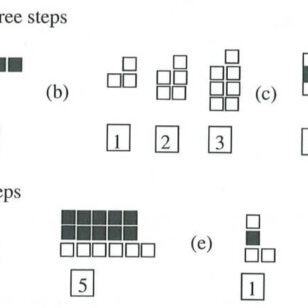
- Awareness of and Expressing Generality: “Picture-pattern sequences (Mason, 1988b; Mason, Graham, Pimm & Gowat, 1983; South Notts, n.d.) provide just one context for generalizing.” Learners are shown a sequence of pictures, and then specify a method describing how the pattern is growing through each term in the sequence, extrapolating these ideas to fit further terms in the sequence
- “Getting learners to make use of their powers is not simply an approach to algebra or even approach to mathematics. It is mathematics.”
Main Reference:
- Mason, J. (2008) ‘Making Use Of Children’s Powers To Produce Algebraic Thinking’ in Kaput, J., Carraher, D. and Blanton, M. (eds.) Algebra In The Early Grades. New York: Lawrence Erlbaum Associates, pp. 57-94
Citations:
- Brown, S. and Walter, M. (1982) The art of problem posing. Philadelphia: Franklin Institute Press.
- Mason, J. (1988b) Expressing generality [project update]. Milton Keynes: Open University Press.
- Mason, J. and Johnston-Wilder, S. (2004). Designing and using mathematical tasks. Milton Keynes: Open University Press.
- Mason, J., Graham, A., Pimm, D. and Gowar, N. (1985). Routes to, roots of algebra. Milton Keynes: Open University Press.
- South Notts Project. (n.d.) Material for secondary mathematics. Nottingham: Shell Centre, University Of Nottingham.
- Watson, A. and Mason, J. (2004) Mathematics as a constructive activity: The role of learner-generated examples. Mahwah: Lawrence Erlbaum Associates.
Buy These Books:
- Algebra in The Early Grades at Amazon.co.uk
- The art of problem posing at Amazon.co.uk
- Designing and using mathematical tasks at Amazon.co.uk