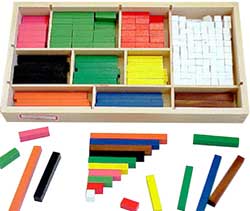


Tomorrow I intend to work with half of my Year 6 group, 12 children, on the included Cuisenaire Rods task from the handbook (an example of the type question we will look at is below).
Georges Cuisenaire was teaching at his school in Thuin in Belgium when he invented these now famous rods as a means of helping his pupils with their study of arithmetic. He made then a discovery now established as a vital component in mathematics teaching today. He found that by making use of children’s natural inclination to play, and giving them an appealing material which demonstrated the relationships on which mathematics is based, it was possible to provide understanding for them all. [Cuisenaire.co.uk]
I know these children well having taught them both last year and this. I know that they enjoy working with equipment and that my teaching over the past couple of weeks has been pretty hands on as we have reviewed our shape transformation work (translation, rotation, reflection etc.). I’m also acutely aware that they haven’t quite managed a solid grasp of fractions yet. They are good at shading fractions of shapes, if those shapes are split into equal segments, and are beginning to apply their ideas to numbers, but some of them find it difficult. However, one bit of teaching that has stuck in their heads is the phrase, “You divide by the bottom and times by the top!” They often repeat this chunk of learning while applying the actions they were taught in Year 4 – hitting their bottoms and heads. I’m never quite sure that they understand why they do this, but it has clung to their brains like chewing gum to a carpet and I may as well take advantage of that.
So, my aims for working with the Cuisenaire Rods are:
- to allow them some hands on work with little recording needed;
- to give them lots of thinking time – time to play with the ideas behind the rods and questions;
- to explore fractions in a different way – I doubt they will have used this equipment before (it always surprises me how, in this computer filled age, the simplest thing like a wooden block can fascinate children in the ways they do);
- to have some interesting discussions about their mathematical thinking. I want to hear their reasoning throughout this task.
Looking at the third bullet point above, Cuisenaire Rods were around when I was at school in the 80s/90s (I left primary school in 1994), but I can’t remember ever seeing them used in our classroom – apart from the single cubes which often appeared alongside the plastic Dienes equipment. It seems that many sets of Cuisenaire have found their way into bins over the years from the discussions at our last meeting. My school clearly either clings onto things or we have an insightful Maths co-ordinator who knows the value of equipment – both in a monetary sense and for their use in teaching. Either way, I discovered 7 sets in school when I looked hard enough… As well as this, there are online versions of the rods available. I’ve included some links at the end of this post.
This makes exploring the task we looked at in the session with my Year 6s an exciting possibility, and one I’m looking forward to. Their job will be to explore the relationships between rods, using their logic and reasoning skills to explain their ideas. One typical question is: “If red is one, what is: a) pink? b) light green? c) blue?”
I fully expect them to compare the rods side by side, possibly using more than one red to work out the ratios between the sizes. I can think of one child who will be able to see the links fairly quickly. He is very visual in his learning but also is able to play with numbers and ideas with ease in his head. He will want a definitive answer to each sum and I may have to work on this as, in later questions, fractional answers are the only realistic sensible answer!
In each question, the rules are reset so that there is a given idea to start with. This will also need to be made clear to some of my children. Another example investigation is, “If brown is 10, what is: a) pink? b) red? c) blue?” Now, this involves colours we’ve previously given values to in pink, blue and red and I know some will fall into the trap of using the previous examples results here.
I am looking forward to seeing how my class get on with this. I will be taking photos of them working and reporting on thei use of language later this week.
Links:
- Online Cuisenaire Rods– a flash file. Click on ‘Rods’, to choose a Cuisenaire rod and then drag it onto the squared background. More rods can be added in a similar way and aligned as you wish. A rod can be rotated by 90° by clicking any key whilst dragging. The background squares can be altered (for example increasing/decreasing their size) using the ‘View’ menu.
- NRICH activity ideas – their search results for Cuisenaire Rods.
- Numicon Number Rods – the current makers of the rods.


